Review the CIS
Confirm the assigned trip and choose the correct next workflow.
Open the assigned CIS from Calendar before requesting gear or creating a Program. The CIS keeps the trip, clients, dates, itinerary, required fishing work, and field notes in one context.
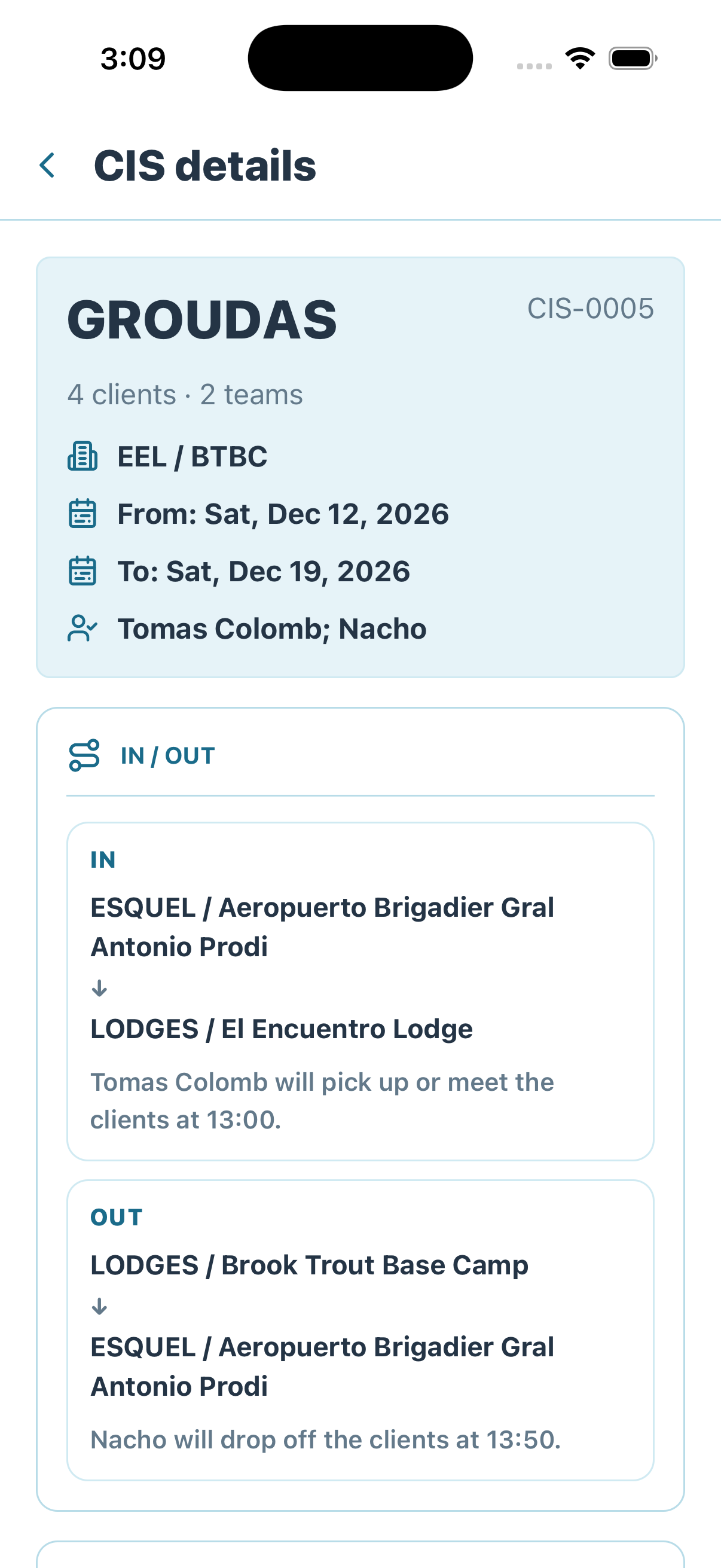
Start with the CIS summary to confirm that the group, dates, lodges, and itinerary match the assigned work.
Review before continuing
- CIS code — Confirm that you opened the exact trip assigned in Calendar.
- Clients and teams — Confirm who belongs to the trip and how the group is organized.
- Lodges and dates — Confirm where and when the assignment applies.
- Assigned people — Understand who is responsible for the trip and its handoffs.
- IN / OUT itinerary — Review arrivals, departures, transfers, timing, and pickup or drop-off responsibility.
If any of these details do not match the Calendar assignment, stop and return to the correct CIS before requesting gear or creating a Program.
Continue through the CIS to review participating clients, required fishing work, access, timing, and Field Notes.
In the Company work view, a linked client profile supplies the current reusable identity, health, preference, email, and phone details when the CIS snapshot is missing or stale. The current CIS remains the fallback. Guide-mode responses do not include canonical email or phone, so the contact section appears only in the authorized Company context.
Needs program means the CIS still requires Program preparation. It does not mean the guide should skip the client or gear review.
Choose the next workflow
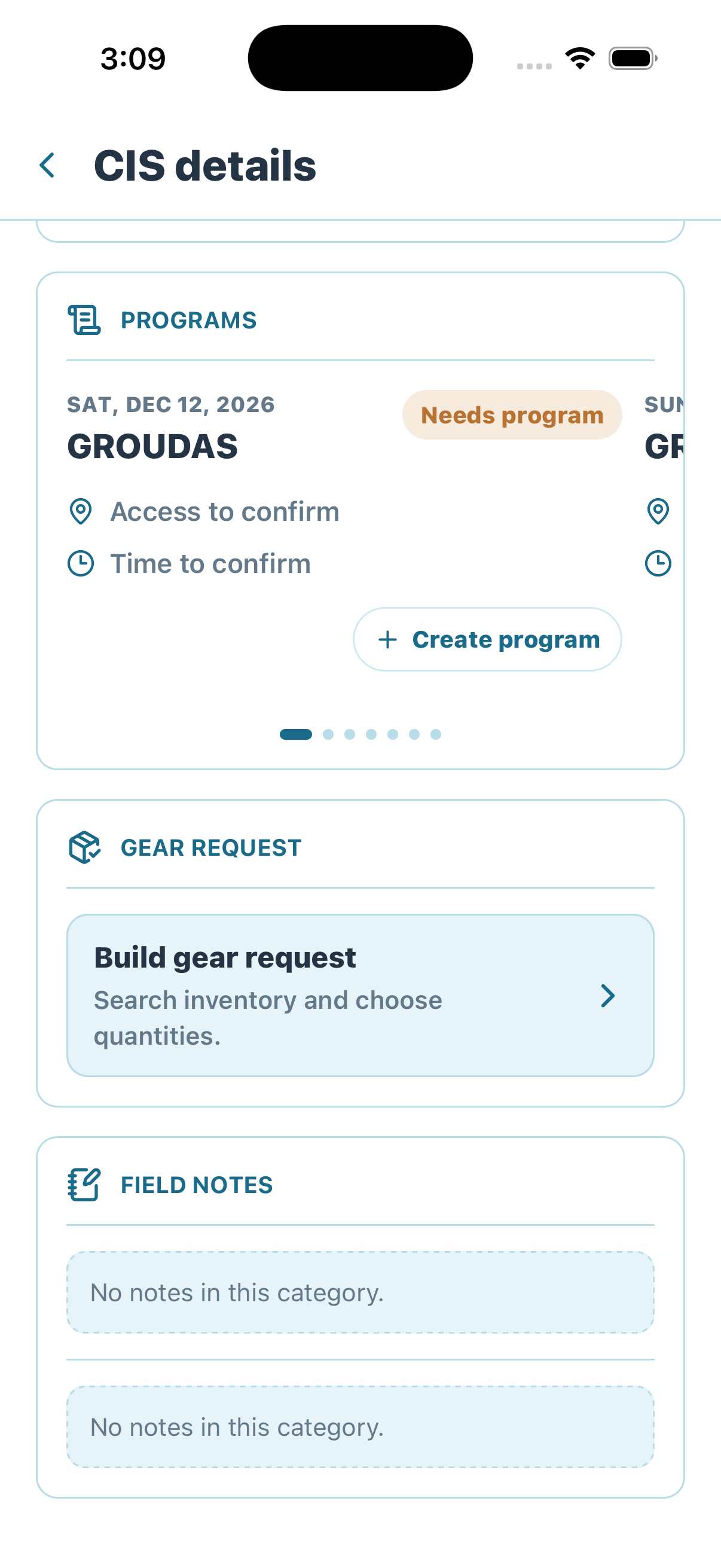
Continue through the same CIS to open Gear Request or begin Program creation.
Two separate next actions
Build gear request records the clients' equipment needs. Create program defines the fishing work. Both remain attached to this CIS, but they are documented as separate workflows.
Guest assignments and your CIS view
With several eligible guides, the group's GC opens Assign guests from CIS Details, chooses a guide, assigns guests from the unassigned list, then switches to the next guide. Save applies the full set of draft changes once. Partial distribution is allowed; unassigned guests do not appear for ordinary guides.
Saved mistakes can be corrected or removed. If another coordinator saved first, reload the latest distribution before retrying. Corrections update access without moving guest-owned gear or rewriting its history. To change guests' guides during the stay, use Rotate guests: the change starts the next day. See Changing guides during the stay.
With exactly one eligible non-transfer guide, all guests belong to that guide automatically and the assignment section is hidden. Transfer duties alone never assign guests. Ordinary guides see only their assigned guests and their own IN/OUT duties. A guide assigned to the CIS for POA work sees every guest and their details, read-only, even before guests are split between guides. The group's GC sees the whole CIS. IN/OUT and Guests can be collapsed independently.
In Management, the CIS marks a requested guide with R. Coordinator duties are daily, so they appear beside the guide on that day's Programs instead: GC Lodge for the lodge's coordinator and GC for a group's coordinator.
Gear status is informational
Missing forms, requests, approval or pickup do not block Program creation. Review equipment progress separately; a Program does not grant access to additional guests.
Next: request the CIS gear.
Need a definition? Open the Trailhead glossary.